



Vitamin D3
It is common knowledge and well agreed upon by many experts in the field that present RDA levels for Vitamin D3 is obsolete. A revision by the Institute of Medicine's Food and Nutrition board is a welcome change but woefully conservative in its recent report of November 30, 2010.
Although the food and nutrition board increased its recommendation three fold up to 4,000 IU , it is my opinion and shared by many of my colleagues that this 4,000 recommendation represents more of the minimal values not the maximum. Common sense always applies. If you are out doors 20 minutes daily during midday sun with significant amount of sun exposed to sunlight you are probably fine. If that is not your daily life style you should consider Vit D supplementation. Wintertime, when sun exposure is minimal, it would be common sense to be conscientious about taking supplementation.
Kinesiological evaluation is useful as well as the standard laboratory test (25(OH) Vit D in evaluating one's blood levels for deficiency.
Again common sense applies that if you have been prescribed a higher dosage by your nutritionist or healthcare practitioner for a specific health concern, that is what your body physiology needs. Remember no one has ever died of Vitamin D excess!
Below is a discussion of the topic by Thorne nutritional company and a link to a PDF article by:
dated November 30th 2010.
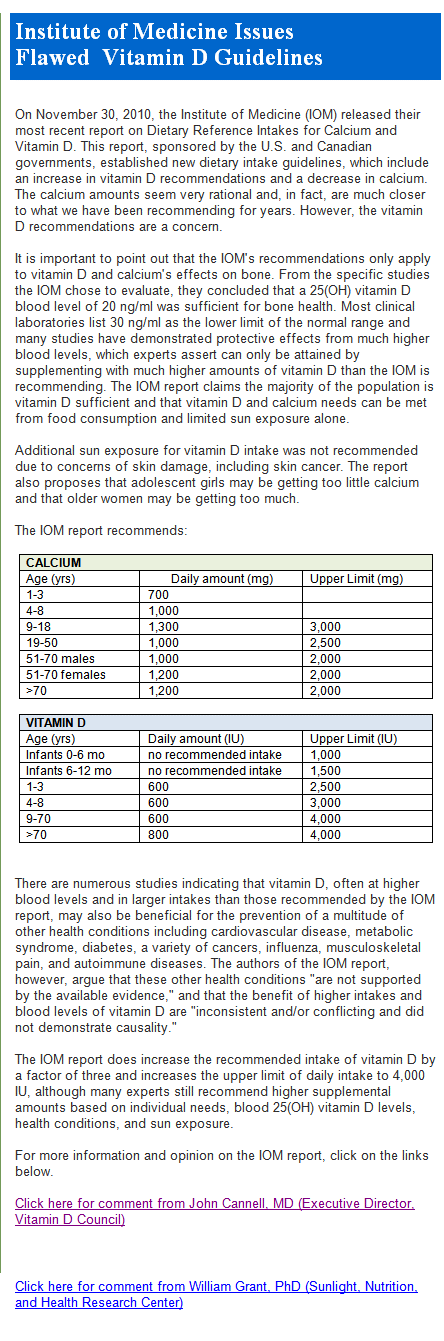


dated November 30th 2010.
(learn from Dr. Lani Simpson)
You Tube Video interview of Carol Baggerly
-
UC San Diego
Additional information at www.grassrootshealth.net
If you can not get 15-20 minutes of mid-day sun during the Winter one should take 4-6,000 units of Vit D3 daily.
Ask your physician to include the Vit D lab test annually as well.
... Optimal blood level values are ~30-60 ng/ml.
The levels of Calcium intake list here are on the high side, I would recommend not exceeding 500mg unless told otherwise by your healthcare practitioner.
Individuals with a neuro-degenerative illness such as MS are often recommended to take much higher levels of Vit D such that their lab test levels are near or exceeding 100ng/ml.
